THE INDO-PACIFIC FAULT LINES
Why Dhaka’s Balanced Diplomacy Is an Economic Imperative M Munir Hossain M Munir Hossain [Updated: Daily-sun, 06 July 2026]
The global political arena is undergoing its most profound realignment since the end of the Cold War. At the heart of this shifting reality lies the Indo-Pacific, a theatre where economic ambitions, technological goals, and regional security concerns converge with mounting friction. The recent 16th Japan-India Annual Summit – which formalised an unprecedented level of strategic closeness between Tokyo and New Delhi – serves as an unmistakable signal that regional dynamics are tightening. For Bangladesh, sitting at the apex of the Bay of Bengal, this changing environment demands more than just passive observation. It requires a highly calibrated, proactive, and unswervingly judicious diplomatic approach rooted in long-term economic development.
Historically, Bangladesh’s foreign policy has been guided by the foundational maxim "Friendship to all, malice toward none.” This pragmatic doctrine shares deep strategic alignment with the vision of the late President Ziaur Rahman, who consistently championed a balanced, non-aligned foreign policy aimed at securing state sovereignty whilst driving economic self-reliance through extensive regional cooperation. While some external observers have occasionally dismissed this approach as a passive or defensive posture, current realities demonstrate that it is, in fact, an active, highly sophisticated, and pragmatic strategy for national survival. In a world increasingly fractured by rigid security blocs and zero-sum diplomatic choices, Bangladesh’s ability to maintain constructive, independent relationships with competing superpowers is its greatest strategic asset.
THE GEOGRAPHY OF
ADVANTAGE
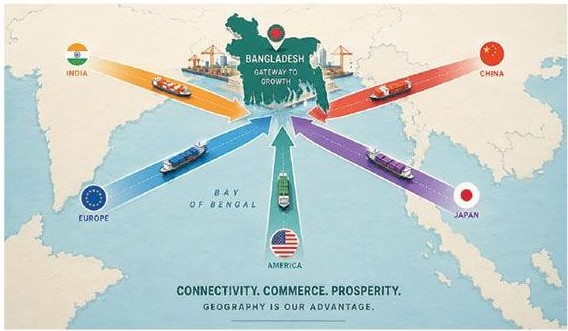
Geography is a permanent reality that dictates the destinies of nations. Bangladesh occupies a uniquely pivotal position, serving as a physical and economic bridge between the dense markets of South Asia and the rapidly expanding economic corridors of Southeast Asia. To our south lies the Bay of Bengal, the world’s largest bay, through which half of global maritime trade passes. This coastal access transforms Bangladesh from a landlocked dependency into a vital maritime gateway. It is precisely this geographical reality that draws the intense interest of major global powers – China, Japan, India, and the United States.
However, geography alone does not guarantee prosperity; it can just as easily attract unwanted strategic entanglement. If Dhaka miscalculates, the Bay of Bengal could easily transition from a zone of peaceful commerce into an arena of volatile naval competition. Bangladesh’s policy must therefore ensure that its territory and territorial waters remain open, transparent, and geared exclusively toward economic connectivity rather than militarised containment strategies. Our leverage lies in being an indispensable partner for trade, logistics, and regional supply chain integration, rather than a frontline state for any single power’s containment doctrine.
BALANCING INDIA, CHINA, AND JAPAN
Managing relations with the three Asian giants requires an exceptional level of diplomatic dexterity. India is Bangladesh’s closest geographic neighbour, and it, sharing a 4,156-kilometre border, remains an essential partner for cross-border electricity grids, inland waterways, railway logistics, and security cooperation. The deep historical and cultural ties between Dhaka and New Delhi are undeniable. However, a pragmatic foreign policy dictates that regional proximity must be balanced with economic diversification. Bangladesh’s growing commercial exchanges and infrastructure integration with India must not preclude robust ties with other economic powerhouses.
Enter China, Bangladesh’s largest trading partner and a crucial driver of its infrastructural development. From deep-sea ports and multi-lane bridges to industrial zones, Chinese capital and technical expertise under the Belt and Road Initiative have been instrumental in bridging Dhaka’s infrastructure deficit. Critics often frame relations with Beijing through the simplistic lens of a debt trap or strategic alignment, but Bangladesh has consistently demonstrated a highly prudent approach to project financing, ensuring economic viability before signing agreements. To compromise our relationship with Beijing would be to self-inflict a severe blow to our industrial and infrastructural modernisation.
“In an era where major powers demand exclusive alignments, Bangladesh’s ultimate strategic autonomy lies in its capacity to remain a neutral ground where global capitals invest in development rather than deploy for deterrence.”
Simultaneously, Japan represents the ideal synthesis of strategic reassurance and developmental reliability. Tokyo’s “Big-B” (Bay of Bengal Industrial Growth Belt) initiative highlights Japan’s vision of turning the Matarbari deep-sea port and the surrounding region into an industrial powerhouse connected directly to Northeast India and ASEAN markets. Because Japan enjoys excellent strategic relations with India and the United States, while remaining a critical economic partner for Bangladesh, Dhaka can leverage Japanese investments as a stabilising force. The Japan-India Special Strategic and Global Partnership, driven by economic needs and regional security concerns, can actually work to Bangladesh’s advantage if Dhaka positions itself as the natural maritime terminus for their joint connectivity corridors.
ENGAGING THE WEST
While regional dynamics dictate our infrastructure and logistics policies, our immediate economic survival and graduation from Least Developed Country status depend heavily on Western consumers. The United States and the European Union remain the primary destinations for Bangladesh’s multi-billion-dollar ready-made garments industry. Beyond commerce, Washington is an influential actor in maritime security, counter-terrorism, and Indo-Pacific governance. Our approach toward the US must remain constructive, emphasising shared interests in institutional resilience, human capital development, climate adaptation, and freedom of navigation.
Dhaka must firmly articulate that its reluctance to join explicit security alignments, such as the Quad or any anti-China coalition, is not an act of hostility toward the West, but a structural necessity driven by its development imperatives. By demonstrating a strong commitment to international law, maritime domain awareness, and regularised dialogue through platforms like the Bangladesh-US Partnership Dialogue, Dhaka can preserve its vital Western export markets while safeguarding its strategic autonomy from external pressures.
SOVEREIGNTY ROOTED IN DEVELOPMENT
Why is it absolutely vital to stay on good terms with everyone? The answer is purely existential: economic development is the ultimate guarantor of national sovereignty. A nation burdened by economic stagnation, high unemployment, or infrastructural isolation cannot effectively defend its borders or project diplomatic weight. Bangladesh is on the cusp of transitioning out of Least Developed Country (LDC) status, a milestone that brings both immense pride and severe commercial challenges, including the loss of preferential tariff treatments. To sustain an annual GDP growth rate capable of uplifting over 170 million people, Bangladesh requires continuous inflows of foreign direct investment, technology transfers, diversified export destinations, and a stable, uninterrupted maritime trade environment.
If Dhaka foolishly chooses one side over another, it risks immediate economic retribution. Alienating China means losing our industrial supply lines and infrastructure funding; alienating the West means devastating our export earnings; alienating India risks border instability and energy supply disruptions; and alienating Japan compromises our most reliable long-term development projects. Therefore, maintaining a balanced, non-aligned foreign policy is not an ideological luxury; it is a hard-nosed economic necessity. Our sovereignty is best protected when all major powers have a vested, financial stake in Bangladesh’s stability and prosperity.
STRATEGIC IMPERATIVE FOR THE NEW ADMINISTRATION
The newly elected administration led by Prime Minister Tarique Rahman inherits these complex regional realities at a critical turning point. To turn its ambitious economic targets into reality, the incumbent government must carefully apply his father’s non-aligned legacy to contemporary global realities. This means Dhaka must approach major capitals through a strictly commercial and developmental prism, framing our strategic geographical value as an asset open for shared prosperity rather than a point of geopolitical friction. By maintaining a clear separation between trade partnerships and military blocs, the administration can build deep economic ties with China as a development ally, while smoothly managing regional resets with India and sustaining access to Western consumer markets. True sovereignty and long-term stability will rely on the government’s ability to ensure that external investments focus strictly on building infrastructure, boosting trade connectivity, and creating local jobs.
A JUDICIOUS PATH FORWARD
To handle the choppy waters of the Indo-Pacific successfully, Bangladesh’s foreign policy establishment must adopt a highly proactive, multi-layered approach. We must aggressively upgrade our domestic ease of doing business, legal frameworks, and logistical infrastructure. External powers will only respect our strategic value if we possess the institutional capacity to absorb their investments and turn them into profitable regional supply chain links.
Furthermore, Dhaka must champion inclusive regional platforms like the Bay of Bengal Initiative for Multi-Sectoral Technical and Economic Cooperation. By embedding our bilateral relationships within robust multilateral frameworks, we can dilute the pressure exerted by single, overbearing superpowers and build an ecosystem where small and medium-sized nations collectively negotiate for regional stability.
Ultimately, the choices made today in the corridors of Dhaka will define Bangladesh’s place in tomorrow’s world. By refusing to become a pawn in the global chess match of containment and deterrence, and by maintaining a steadfast commitment to mutual respect, sovereign equality, and peaceful commerce, Bangladesh can transform its geographical vulnerability into an unassailable strategic advantage. Our message to the world must remain unwavering: Bangladesh is a land of economic opportunity, a bridge between civilisations, and a partner for peace – a friend to all and an instrument of none.
The writer is Deputy Editor,
the Daily Sun.
Email: munir.hossain@daily-sun.com