Climate, policy and water risk
Samanta Azrin Prapty [Source: New age, 03 January, 2026]
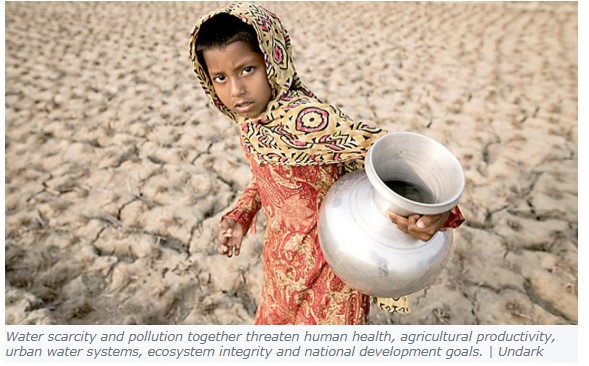
BANGLADESH, historically renowned as a fertile delta sustained by countless rivers and abundant freshwater, now faces an unprecedented water security crisis in the mid-2020s. This is not merely an environmental fluctuation but the cumulative result of decades of policy neglect, weak institutional governance, and inadequate international water diplomacy. Water scarcity and pollution together threaten human health, agricultural productivity, urban water systems, ecosystem integrity and national development goals. The crisis demonstrates that water in Bangladesh is no longer a taken-for-granted resource but a contested and increasingly fragile commodity, revealing fundamental flaws in law, governance and planning.
Regions once considered water-rich, such as the Barind tract, are now officially ‘water-stressed,’ reflecting severe depletion of usable water resources due to unsustainable extraction, climate variability, and inadequate adaptation measures. Authorities have intensified river monitoring and pollution enforcement, yet these actions remain reactive rather than integrated into a comprehensive water security strategy. Water scarcity has shifted from a prospective threat to a daily crisis, undermining public health, food production, industrial output and the state’s capacity to ensure basic human rights to clean water and sanitation.
The Bangladesh Water Act 2013 was designed to manage, protect, and conserve the country’s water resources through coordinated development, abstraction, distribution, and utilisation. In practice, however, the law has been compromised by weak enforcement, overlapping institutional responsibilities, and outdated policy frameworks such as the National Water Policy 1999 and the National Water Management Plan 2001. These frameworks have failed to accommodate contemporary challenges, including transboundary water stress, climate change impacts, and urban-industrial pollution. Scholarly critiques emphasise systemic deficiencies across related statutes — including the Groundwater Management for Agriculture Act 2018, the National Commission of River Protection Act 2013, and the Water Resource Planning Organisation Act 1992 — collectively revealing incoherence, lack of accountability, and an inability to respond to emerging water security threats.
Environmental degradation mirrors these legal and governance failures. Rivers once central to Bangladesh’s cultural and ecological identity are now ‘dying,’ burdened by industrial effluent, domestic sewage, encroachment, and sedimentation. Dissolved oxygen levels in critical rivers such as Buriganga, Turag, Sitalakhya and Karnaphuli have plummeted, rendering stretches ecologically unviable. Heavy metal and nutrient contamination in these waterways far exceed safe limits for drinking and irrigation, transforming rivers into ecological dead zones and public health hazards. Urban water networks, particularly in Dhaka, are similarly compromised: canals like the Khidir have become stagnant, polluted ditches that undermine drainage, increase vector-borne disease risks and heighten respiratory and waterborne health hazards.
Groundwater exploitation has intensified, especially in urban areas such as Dhaka, where daily demand often exceeds hundreds of millions of litres. These withdrawals surpass sustainable yields, threatening aquifer viability and long-term urban water security. In rural areas, excessive irrigation for rice monoculture has created social and economic distortions, with some communities experiencing water shortages even during monsoon months. The absence of integrated water accounting, auditing and allocation mechanisms illustrates how administrative shortcomings have rendered water governance opaque, reactive and technically uninformed.
Transboundary water politics exacerbate these challenges. International standards, including the 1997 UN Convention on the Law of Non-Navigational Uses of International Watercourses, obligate riparian states to cooperate, prevent significant harm, and ensure equitable utilisation of shared resources. In practice, however, Bangladesh struggles to enforce these principles. Upstream policies by India, particularly regarding the Teesta river, demonstrate how realpolitik undermines transboundary water governance. The absence of binding, enforceable agreements has allowed upstream unilateralism to dictate downstream flows, amplifying the impacts of scarcity and constraining Bangladesh’s capacity to secure environmental and human rights objectives.
Climate change compounds the crisis, driving salinity intrusion into coastal aquifers, altering monsoonal rainfall, and destabilising freshwater ecosystems. Rising salinity threatens both drinking water and agricultural productivity in coastal zones, while erratic precipitation and floods further strain surface water supplies. Combined with overexploitation and contamination, these changes magnify vulnerability for urban and rural populations alike, rendering water insecurity both chronic and escalating.
The human toll of these failures is severe. Only a fraction of Bangladesh’s population has access to safely managed water, with as few as 14–15 per cent linked to piped supply systems. Contamination with pathogens such as Escherichia coli, along with arsenic and other toxins, disproportionately affects low-income households, resulting in waterborne diseases, developmental impairments and chronic health problems. Arsenic contamination, a long-term consequence of policy decisions intended to reduce surface water pathogens, has inflicted intergenerational health impacts, including skin lesions, cancers and debilitating co-morbidities. The intersection of policy errors, environmental mismanagement and social inequity demonstrates how water insecurity in Bangladesh is not only a technical or ecological issue but a profound matter of environmental justice.
Urban planning and industrial regulation have failed to mitigate these risks. Industrial effluents continue to flow untreated into rivers, encroachment persists along canals and infrastructure investments prioritise short-term economic gains over ecological sustainability. Agricultural water management is equally problematic: institutional incapacity to enforce equitable water distribution, combined with the demand for high-yield rice, has driven excessive extraction and groundwater depletion. National governance remains fragmented, with ministries and agencies operating in silos, undermining accountability and preventing the adoption of integrated water resource management.
International law alone cannot resolve these challenges. Bangladesh’s position as a downstream state exposes it to ecological costs imposed by upstream actors, while climate change and domestic mismanagement compound pressures. The aggregate effect is a systemic crisis: water resources are depleted, rivers deteriorate, aquifers face overdraw, and human populations endure preventable diseases, compromised livelihoods, and diminished resilience in a warming climate. Legal and institutional frameworks, intended as instruments of governance and protection, have become largely symbolic, offering rhetorical shields while the crisis intensifies.
Addressing Bangladesh’s water security crisis demands urgent, coordinated action. Legislation must be updated and enforced, institutions streamlined, and climate-adaptive water management embedded in planning. Transboundary diplomacy must secure equitable and reliable flows, with binding agreements ensuring environmental and human rights standards. Urban planning must integrate ecological safeguards and water-sensitive infrastructure, while agricultural policy should prioritise sustainable extraction and fair distribution. Without such comprehensive reforms, water will cease to be a shared public resource and become a scarce, contested commodity, with dire implications for human health, environmental sustainability, and national development.
The water crisis in Bangladesh is not inevitable. It is the product of systemic legal, institutional and diplomatic failures. Correcting course will require political will, technical knowledge, and social accountability. The nation must act decisively to restore the ecological, legal, and institutional foundations that underpin water security, or risk allowing its most vital resource to slip beyond sustainable reach.
Samanta Azrin Prapty is a legal researcher and writer.