A new strategic lens on Bangladesh-Myanmar ties
Lt Col Md Abdullah Al Mamun, psc, Engineers [Source : Daily Observer; 1 & 2 January 2026]
A new strategic lens on Bangladesh-Myanmar ties
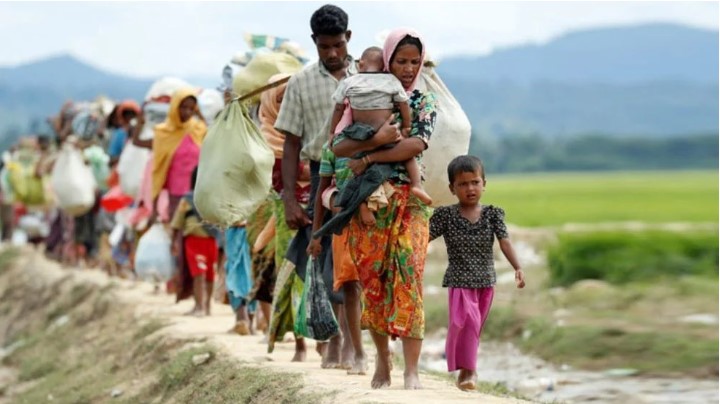
Bangladesh-Myanmar relations has so far been riddled with uncertainty and doubt. The primary issue of Rohingya repatriation is now only one of the issues that plagues both parties to various degrees. Whether the Naf river between the two countries is a symbol of this, or whether it is a symbol of hope depends on two aspects of this relationship: What "developments" are happening in this region, and what Bangladesh can do to position itself to benefit both parties. It is common knowledge that these two countries have a shared root that runs deep throughout history, but to utilize this root to manifest. Myanmar is divided right now, and that isn't a good sign for the region while Bangladesh and Myanmar are both suffering from issues near the shared border. Bangladesh has a serious role to play if it were to help rectify this dilemma at present.
Myanmar's Transition and the Regional Aftershocks: Myanmar's politics is and has been centered around its Military regime, namely, the Tatmadaw. Again within its turbulent political history, the country also has a very unique example of regime shifts. It's very short democratic regimes lasted only a decade (2011-2021), and that transitioned into the current military regime after the 2021 coup. Myanmar has been largely isolated from the wider geopolitical network afterward, with conflicts cascading through its various provinces. The Tatmadaw has been trying with difficulty to maintain their control over the regime so that a unified Myanmar under their control may persist, but the recent developments of territorial control shows that various ethnic armed groups have controls well over more than half of the country. The closed briefing of Myanmar officials with delegations from neighbouring countries reveal that the Tatmadaw are not overly concerned with losing their control as a regime over the country. This confidence is commendable, yet that does not change that as its neighbour, Bangladesh needs to be largely objective about its present and future options of diplomatic navigation.
All this might sound bleak since it is nearing a decade since the last mass exodus of Rohingyas in 2017, but there is an opportunity for Bangladesh. The opportunity for dialogue, regional coordination, and regional repositioning is now present for the Bangladesh even during Myanmar's current internal fragmentation. Presently, some of the global superpowers are taking serious notice of Myanmar. China and India are investing heavily in infrastructure projects all over this country. India even has its own Act East strategy to coordinate such developments. The U.S. is starting to take notice of how important this country is with how it quietly removed some of the past sanctions this July. What Bangladesh can do in this scenario is to carefully leverage its position as a humanitarian responder and as an immediate neighbour to Myanmar to shape the regional discourse on Myanmar. Now the question is, how Bangladesh is supposed to achieve that?
Between Global Powers and Regional Developments: The evolving geopolitical landscape between Bangladesh and Myanmar is very different from what it was only a decade ago. Presently, major powers are positioning themselves to take initiative of the Bay of Bengal region. China has its own China-Myanmar Economic Corridor (CMEC) and the Kyaukphyu Deep-Seaport. India is investing nearly as much as China in Myanmar's infrastructure projects near its coastline. It is even working with the U.S., Australia, the Japanese government as a sort of collective to boost these projects to completion.
Bangladesh has opted to have "cordial" relations with all of its bilateral partner countries as part of its foreign policy. This has had obvious benefits for the country. But the other side of the coin is in how it has to carefully balance its non-military dealings without compromising its sovereignty.
Bangladesh simply cannot jump into the regional politics of the big countries. But even while doing just that, the country can reap economic benefits if it carefully navigates this landscape. However, they have not accounted for Myanmar being a bridge to those channels. If Bangladesh plays it right, it can leverage a close relationship with Myanmar to further its access to the South East Asian region.
(To be continued)
Concluding Part
What this means is that Bangladesh cannot afford to isolate Myanmar amid the bilateral talks of the Rohingya crisis. There needs to be a deeper level of cooperation developing between the two. If not, projects such as the Asian Highway, BIMSTECT connectivity projects, and future trade corridors may potentially grind to a halt from a lack of meaningful coordination and understanding. The Rohingya crisis should not be used to potentially cripple cooperation in these other areas. Isolating agendas is key here to achieve a mutually beneficial coordination of regional developments and shared interests.
Isolating Agendas with Patience: Some have observed that Bangladesh has been "strategically patient" in its regional dealings concerning the Rohingya population. This is because of three aspects that the country has to carefully consider. It has to first maintain it position as state that adheres to basic humanitarian principles, that it has to be open to a future possible repatriation initiative through a mutual understanding with Myanmar, and that it has to routinely protects its shared border with Myanmar. Bangladesh has so far shown that it understands how its regional reality works and how to maintain a degree of balance when developments do not work in its favour. Bangladesh cannot consider coercing Myanmar on this issue, especially not with how China is engaged with it in defence and infrastructure. Bangladesh has instead chosen a different approach of making the Rohingya crisis and international issue so that the UN, the OIC and ASEAN partners and the wider international community takes notice of this issue and extend their support. This approach has seemed to work thus far, but many are still uncertain as to how long that will be the case for Bangladesh. Repatriation is still stagnant and the shared border continues to be a headache for the country.
What Can Bangladesh Do Here?
Bangladesh can, surprisingly, consider several viable approaches to deepening relations with Myanmar and then navigate the regional geopolitical landscape:
* First by starting off with shared concerns. Both countries have some serious shared issues that they need to deal with as soon as possible: reduced trade from pre-2017 era, drug trafficking, arms smuggling, human trafficking, insurgent movements, and climactic events and disasters.
" The opening of formal trade channels can address the reduced trade.
* The opening of joint counterterrorism measures can address the border issues.
* The expression of shared environmental concerns as climate affected countries in global climate forums (The IPCC, the COPs, and the GCF to name a few) can help mobilize initiatives that help these two countries in their shared climate concerns. Bangladesh can definitely help with spearheading the latter, since it is one of the global leaders in climate resilience and adaptation and disaster preparedness.
* This does not mean that Bangladesh should ignore the regional platforms, namely, BIMSTEC and ASEAN. But since these platforms have been used to bring forward contentious issues of bilateral and multilateral dispute with Myanmar (humanitarian concerns, border issues, regime control issues to name a few), Bangladesh should instead focus on promoting multilateral diplomacy to promote a shared culture of peace and accountability. The issues that have been raising dispute can come much later in the discussion after relations have deepened considerably enough between the two countries.
This brings us to the discussion on how to continue the Rohingya issue. That should be, first and foremost, kept separate from all the previous modes of approach discussed so far. If it is kept as strictly a humanitarian issue, with engaging humanitarian agencies, as part of shared global humanitarian affairs, then it will not clash with the other areas. These other areas of shared issues can then be kept separate and be used to deepen bilateral ties with Myanmar. Not to omit a key part of a country's population, the civil society, the business community, and the academia of Bangladesh can be involved in track 1 and 1.5 dialogues with Myanmar to open up communications with Myanmar's wider diaspora, so that connections between the two countries continue to deepen even if situations worsen in Myanmar. If all of this is taken into account, the Naf river will indeed become an actual symbol of shared peace.
The writer is an Army Officer